Beyondthe Screen

Linus Vock
Designer and developer - applying for M.Sc. UX Design at THI.
Trained in both design and computer science at Hochschule München, I work at the seam where software and craft meet.
I care about interfaces that feel reasoned, legible, and quietly inventive.
- 2022B.Sc. Informatik und Design- MUC.DAI, HM München
- 2024Internship - mid-sized systems house & IT service provider- 1 semester
- 2024Tenbyte Technologies GmbH- alongside studies, ongoing
- 2026Bachelor thesis- Reworking the interface of HM's central student platform
- nowApplication - M.Sc. User Experience Design- THI Ingolstadt
Timeline
Tools & technology
A rough inventory of what I reach for - move the cursor and the field reacts.
Selected work
Four projects across research, design, and engineering. Each has its own chapter below.
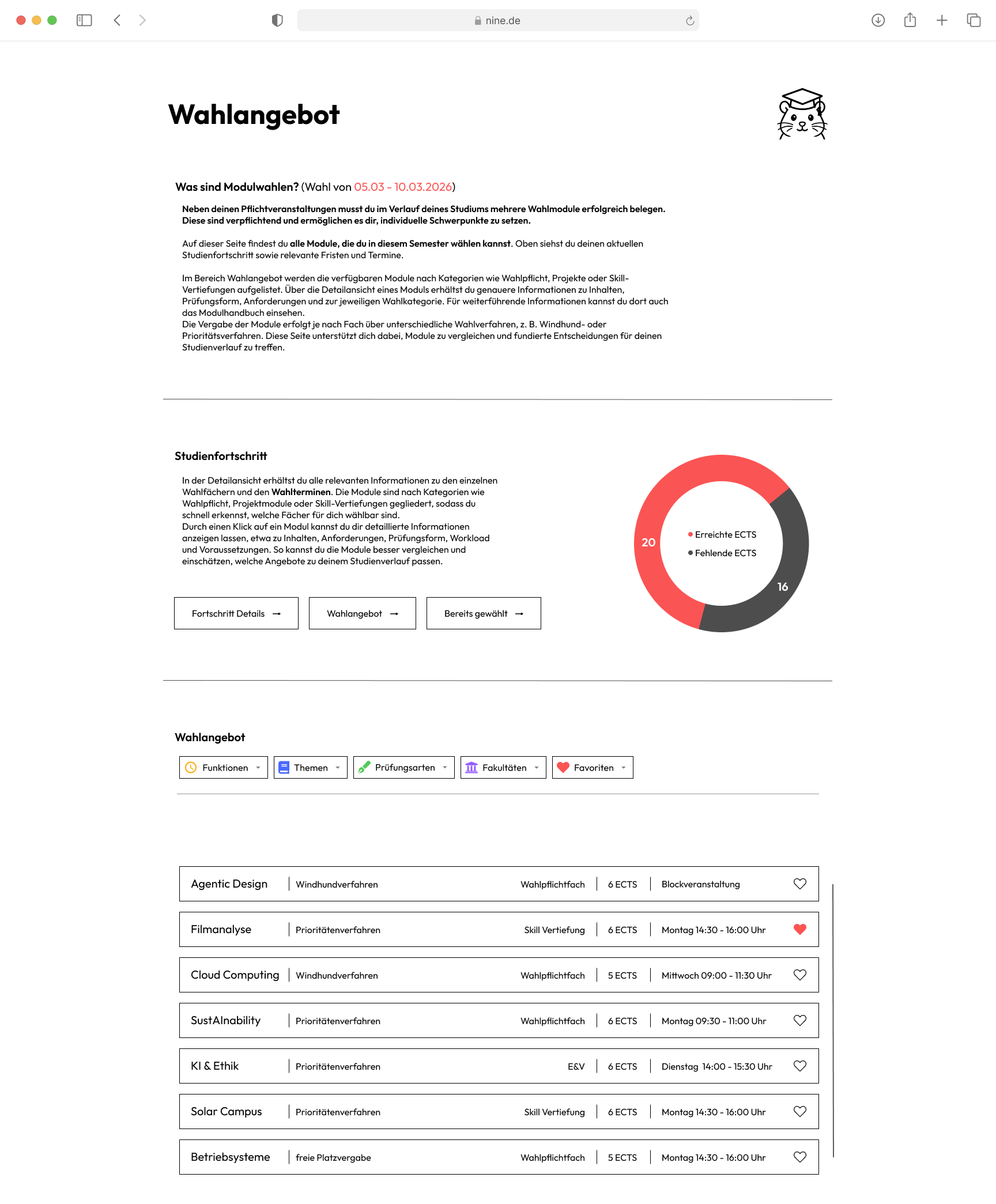
Study Portal
Redesigning the voting process of a study portal at Hochschule München to help students make better-informed module choices.

MetaLibrary
A private meta library for competitive GeoGuessr. Low friction, high recall.
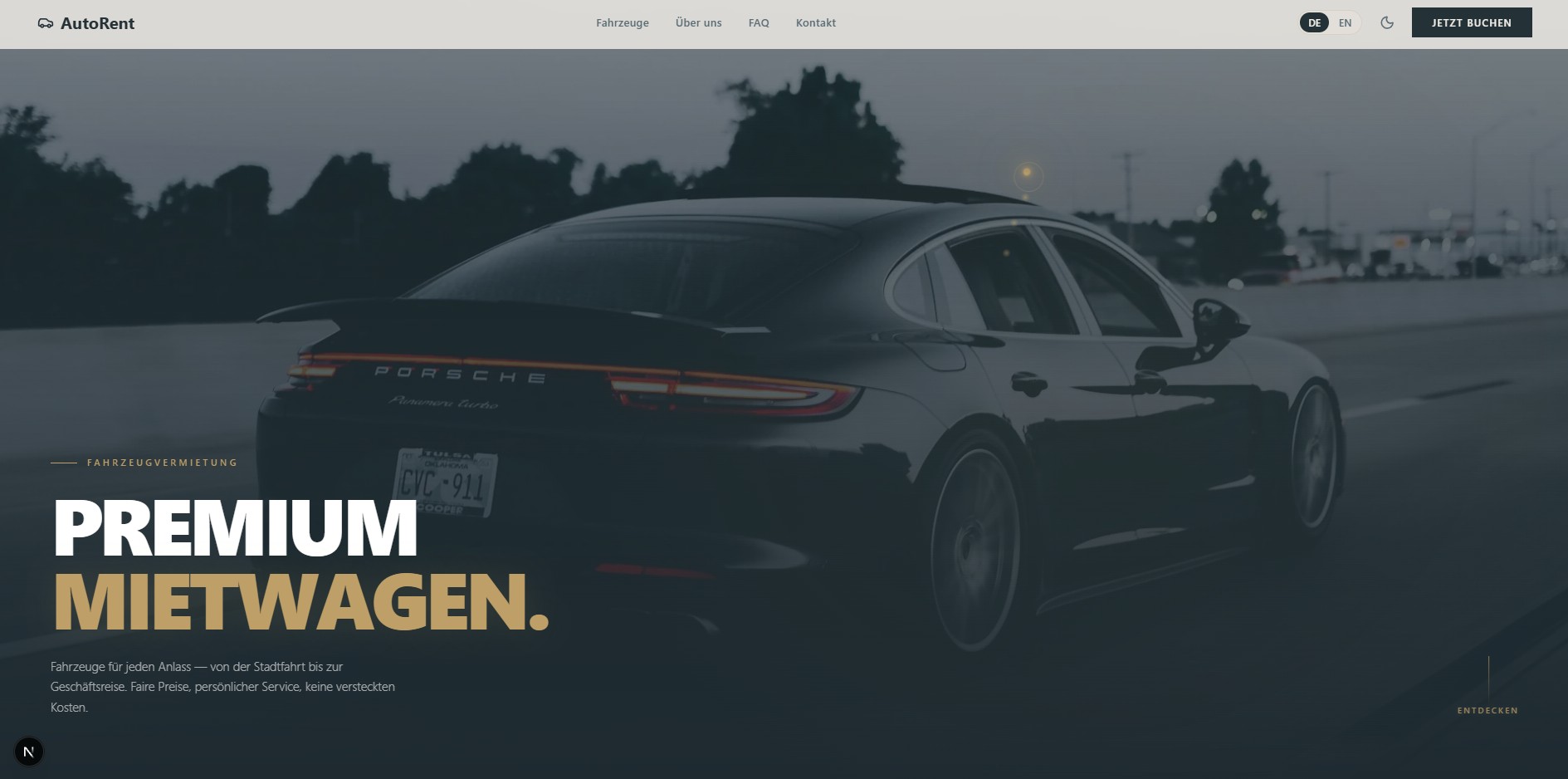
Autorent
A white-label rental platform for any car rental business. Bespoke front end, complete admin control.
Climate Quizzard
Voice-driven AI quiz installation on climate change. Speak your answer, watch it light up.
Study Portal
Redesigning the voting process of a study portal at Hochschule München to help students make better-informed module choices.
- Role
- UX Researcher & Designer
- Duration
- 5 months
- Stack
- Figma (high-fidelity prototype)Qualitative user interviewsPersona synthesisUsability testing
Problem
Students at Hochschule München regularly ended up in modules that didn't match their expectations - wrong workload, unclear exam formats, content that wasn't what they signed up for. The existing portal "nine" offered little more than a bare module list with inconsistent descriptions, no progress context, and no way to compare options side by side. We set out to understand why mismatches kept happening and what a better selection experience could look like.
Role
We conducted qualitative user research with six students and four faculty members and administrative staff, synthesized findings into personas and design principles, and designed an end-to-end interactive prototype in Figma - covering both the student-facing selection flow and a structured module creation tool for instructors.
Outcome
A clickable high-fidelity prototype that reimagines course selection as a guided, transparent process: a unified overview with inline progress tracking, filterable module listings with schedule conflict detection, standardized module detail pages, and a drag-and-drop prioritization view. A usability study with six participants showed strong task completion rates across most scenarios, with clear pointers for where the finalization step still needed polish. On the instructor side, we designed a three-step module creation flow - including an AI-assisted mode - that standardizes descriptions and integrates a quality preview before publishing.
MetaLibrary
A private meta library for competitive GeoGuessr. Low friction, high recall.
- Role
- Solo build, end to end
- Duration
- ongoing
- Stack
- Next.js 16React 19TypeScriptPrisma + SQLiteTailwind CSSD3 (interactive globe)Sharp (image pipeline)Cloudflare Access (Google sign-in)
Problem
In GeoGuessr, strong players learn to read metas - small visual clues in Street View (road lines, bollards, plates, vegetation, camera generation) that reveal where a location is. That knowledge is scattered across videos, Discord chats, and private notes, with no fast way to look it up. My friends and I wanted one place to collect these clues and query them the way we actually reason mid-round.
Role
Solo build, end to end - concept and data model, full stack (Next.js 16, React 19, TypeScript, Prisma/SQLite), an image-processing pipeline for clue screenshots, and the UI design. Deployed behind Cloudflare Access with Google sign-in, restricted to our group.
Outcome
Every meta is tagged, illustrated, and weighted by how strongly it points to a region. The core feature is a reverse-lookup engine: pick the clues you're seeing and get a scored, ranked list of the most likely countries and regions. The same library is explorable three ways for different learning styles - a weighted search, a tag browser, and an interactive 3D globe - so the group can study up front and decide in the moment.
Autorent
A white-label rental platform for any car rental business. Bespoke front end, complete admin control.
- Role
- Sole designer and full-stack engineer
- Duration
- Multi-month build
- Stack
- Next.js 16TypeScriptTailwind v4shadcn/uiBetter AuthSQLite + Drizzle
Problem
Independent car rental companies almost always run on generic, interchangeable websites. The brief: one Next.js full-stack codebase that works for any rental business - economy to luxury - while looking bespoke rather than like an off-the-shelf build.
Role
Sole designer and full-stack engineer. I built the product end to end: the customer-facing frontend, the complete admin panel, role-based authentication, the database layer, and full DE/EN internationalization.
Outcome
A production-ready, white-label template pairing a premium automotive aesthetic with an admin panel that leaves nothing to be desired - fleet, bookings, messages, team, and user management. Ready to sell on marketplaces or tailor to an individual client.
Climate Quizzard
Voice-driven AI quiz installation on climate change. Speak your answer, watch it light up.
- Role
- Solo build, end to end - concept, hardware, and full stack
- Duration
- Multi-week build
- Stack
- Python + FlaskOpenAI Assistants APIVosk (offline speech-to-text, German)pyttsx3 (text-to-speech)sounddevice (audio capture)Next.js 14 + React + TypeScriptArduino + pySerial (LED strip control)
Problem
Climate education usually arrives as a wall of text - passive, easy to tune out, and rarely something you do. I wanted a public installation that turns the topic into a short, spoken conversation: something a visitor could walk up to, talk to like a quizmaster, and get an immediate, physical reaction to. No keyboard, no screens to read through, no app to install - just step up and speak.
Role
Solo build, end to end - concept, hardware, and full stack. I built the Python/Flask backend, wired it to the OpenAI Assistants API to generate and moderate the quiz live, integrated offline German speech recognition (Vosk) and text-to-speech so the exhibit talks back, wrote the Arduino firmware and serial protocol driving the LED strip, and built the Next.js/React/TypeScript frontend that displays each question and its answer options. Designed and run as a standalone physical installation.
Outcome
A working exhibit that runs an entire quiz as a spoken dialogue. The AI moderator greets the visitor, gauges their confidence level, and adapts its questions on climate change and environmental protection in real time. The visitor answers out loud; Vosk transcribes the speech on-device, and the answer is scored instantly - a correct answer lights the LED strip green, a wrong one red, with the moderator explaining why before moving on. Running entirely offline for the voice layer kept it fast and reliable on the exhibition floor, where it engaged visitors end to end exactly as intended.
I design interfaces that feel reasoned - and see them through to technical execution.
My path ran through Informatics & Design at Hochschule München - building and questioning in the same breath. The M.Sc. UXD at THI is the next step: one discipline, one vocabulary.